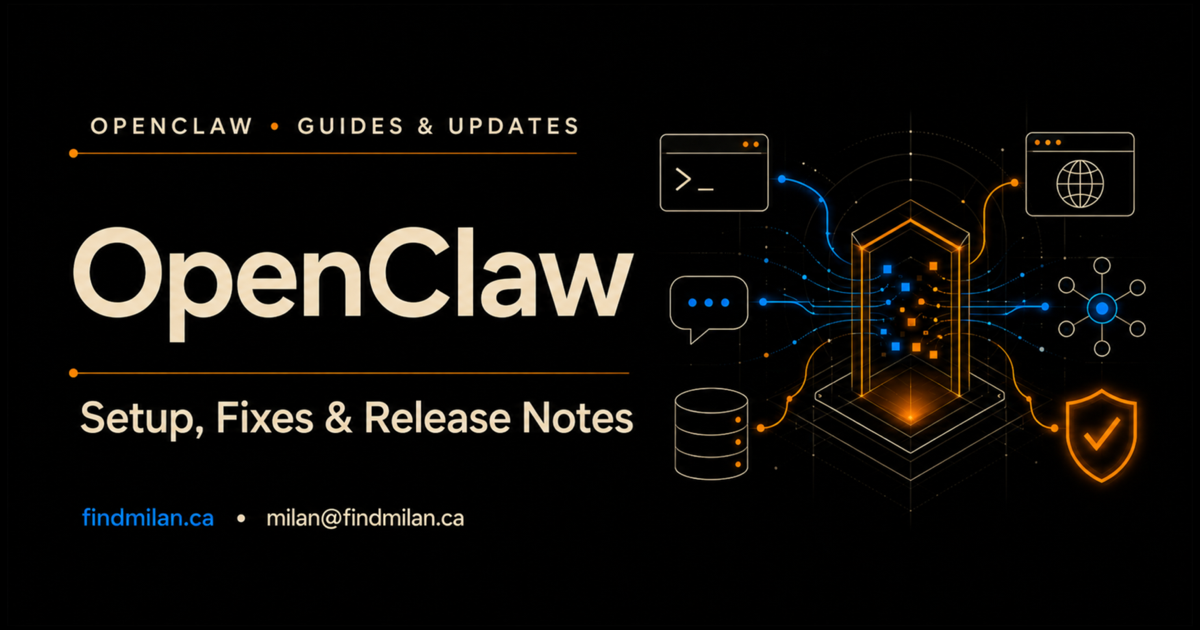
OpenClaw’s architecture is straightforward once you stop thinking of it as “just the dashboard.” The official docs consistently describe the gateway as the control plane, while the dashboard, channels, browser tooling, models, and companion devices are connected surfaces around it.
Quick answer
If you understand four moving parts, you understand most of OpenClaw: the gateway, the assistant runtime, the connected surfaces, and the security boundary. Everything else is an implementation detail on top of those pieces.
1. The gateway is the control plane
The README and quickstart docs both center the gateway. It keeps sessions, channels, tools, and events together, and it is the piece you must keep healthy if you want the rest of the stack to feel stable.
2. The dashboard is an admin surface, not a public landing page
The official dashboard docs explicitly call the Control UI an admin surface. It is meant for chat, configuration, approvals, and debugging, which is why the docs tell you not to expose it publicly and to prefer localhost, Tailscale Serve, or SSH tunneling.
3. The browser tool is its own lane
The browser docs describe a dedicated agent-only browser profile. That isolation matters because it prevents the assistant from sharing your personal browser profile while still enabling screenshots, clicks, PDFs, and controlled browser actions.
4. Channels are not just transport
Telegram, Slack, WhatsApp, Discord, and other channels are where the assistant actually meets users. In practice, that means channel setup is partly product design and partly security design. Pairing, allowlists, and DM policy choices decide who can actually reach the assistant.
5. Models and tools sit behind the assistant
Model selection, tool use, browser automation, memory, and web access all sit behind the assistant runtime. That is why a channel can appear “broken” even when the real cause is model auth, browser state, or a gateway health problem.
Common architecture mistakes
- Treating the dashboard as a public app instead of a protected admin surface.
- Debugging channel behavior before confirming gateway health and model auth.
- Running browser automation without isolating the profile or thinking through remote-host constraints.
- Letting multiple ad-hoc auth methods pile up until nobody knows which secret the gateway is really using.
The architecture questions to answer before production
- Where will the gateway run and who owns that machine or VPS?
- Which channels need to be live on day one and which can wait?
- How will the dashboard be reached without exposing it publicly?
- Which model providers are primary, fallback, and local-only?
- Which actions require human approval or tighter allowlists?
Why this matters for lead quality
The teams most likely to become good OpenClaw clients are the ones asking architecture questions early. Once a buyer understands that the gateway, dashboard, browser, models, and channels are one system, they stop treating setup as a copy-paste task and start treating it like real delivery work.
Frequently asked questions
What is the OpenClaw gateway?
The gateway is the control plane. It is the long-running service that keeps the assistant, sessions, channels, tools, and runtime state together while exposing the dashboard and other connected surfaces.
Is the OpenClaw dashboard the product?
No. The dashboard is an admin and control surface for the gateway. It is useful, but the assistant environment is larger than the browser UI alone.
How does the OpenClaw browser feature fit into the architecture?
The official browser docs describe an isolated, OpenClaw-managed browser profile that the agent can control. It is intentionally separate from your personal browser profile and should be treated as a safe automation lane, not your daily browser.
What usually breaks first in a real deployment?
Remote access, dashboard authentication, channel pairing rules, and model/provider configuration are the common first break points. The architecture is powerful, but it rewards clean setup discipline.