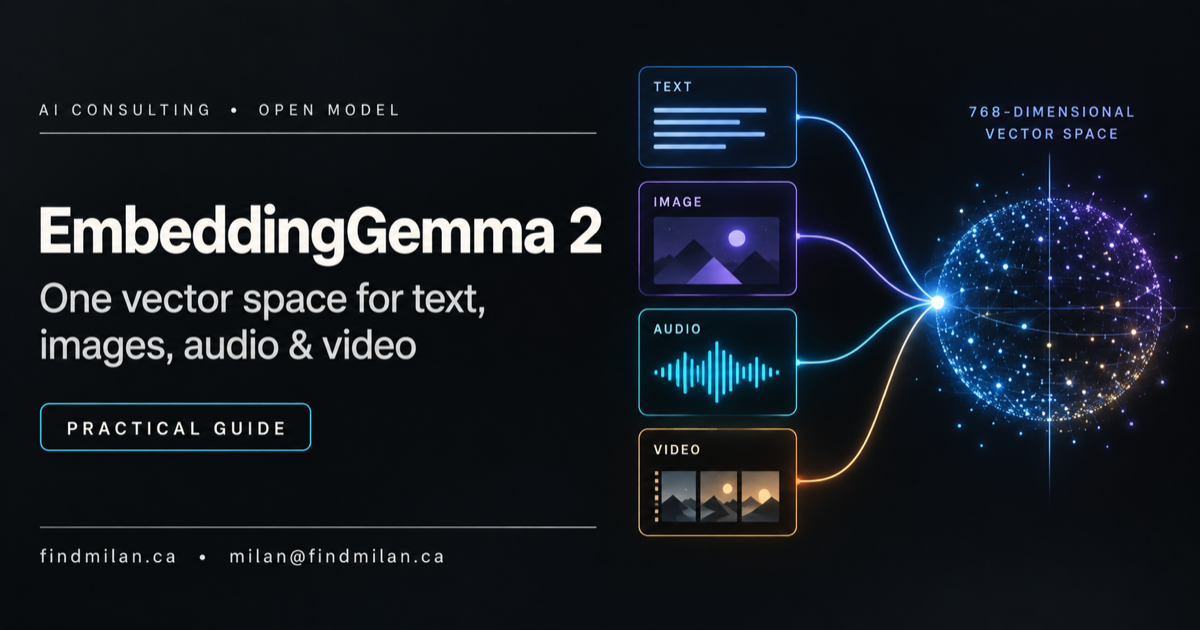
Google’s EmbeddingGemma 2 gives developers one open model for turning text, code, images, audio, and video into comparable search vectors. Its practical hook is not that it writes answers; it can help an application find related material across different media, with modular model sizes that let teams start with fewer modalities and add encoders when needed.
The linked video is titled “Introducing EmbeddingGemma 2: An open model for natively multimodal embeddings.” This guide explains the release using Google’s written developer documentation and model card as the technical references. The video title identifies the subject; product details below are verified against those first-party sources.
What EmbeddingGemma 2 does
An embedding model converts content into a list of numbers, called a vector, that represents useful semantic relationships. A search system can compare vectors to find items that are related even when they do not use the same words.
EmbeddingGemma 2 extends that idea beyond text. Google describes a shared 768-dimensional space for text, code, images, audio, and video. A product could therefore embed a written query and compare it with image or video content, or search an audio archive using a text description. The model returns representations; your application still has to store them, retrieve candidates, apply access rules, and decide what to show.
That distinction matters: embeddings are not a chatbot response, a complete search engine, or a guarantee that the top match is correct. They are one component in a retrieval pipeline.
A modular model instead of one fixed footprint
Google’s developer guide describes configurations that load only the encoders a project needs:
- 270 million parameters: text and code.
- 440 million: text, images, and video, with the vision encoder.
- 570 million: text and audio.
- 740 million: the full multimodal configuration.
Each configuration projects into the same vector space, according to Google. That makes it possible to begin with text-only indexing and later add another modality without automatically forcing a separate embedding space. Before changing a production index, still test compatibility, retrieval quality, and any re-indexing requirements in your chosen runtime.
The model is released with open weights under Apache 2.0. Google says the model is designed to run locally and offline on consumer hardware. “Can run locally” is not a hardware promise for every laptop: inference speed and memory depend on which encoders are loaded, model precision, input size, and the device.
Where it can fit
Search across a media library
Embed photos, clips, transcripts, and descriptions, then let people search using the kind of query that feels natural to them. For example, a text query like “a red canoe beside a dock at sunset” could be compared with image and video embeddings. The retrieval system would return candidates for a human or a later ranking step to inspect.
Google’s multimodal guide describes video processing through sampled frames; the default sampling rate is one frame per second and can be configured. This is useful to understand when planning a video index: temporal detail between sampled frames may not be represented unless you adjust the sampling approach.
Grounded search for a RAG assistant
For retrieval-augmented generation, the embedding model retrieves relevant passages or media references. A separate generative model can then use those results to draft an answer. Keeping retrieval and generation separate makes it easier to measure whether the system found useful evidence before evaluating the answer-writing step.
Google recommends task-specific text prefixes for embedding queries and documents, and its examples distinguish query-side and document-side prompts. Use the documented prompt names or prefixes for your selected library version; mismatched query and document formatting can weaken retrieval even if the code runs.
Code and technical-document discovery
The text-and-code configuration can support semantic code search or technical-document retrieval without loading image and audio encoders. Google reports a 14% improvement over EmbeddingGemma 1 on its Code MTEB evaluation. That is a vendor-reported benchmark result, not evidence that every repository or programming language will improve by the same amount. Build a small test set from your own codebase and compare relevant results against the current search method.
A practical evaluation path
Start with a narrow question. For example: “Can a staff member find the right product photo from a short text query?” Then:
- Choose the minimum encoder configuration that covers your content.
- Create a representative set of queries and known relevant items.
- Apply the model’s documented query and document prompts consistently.
- Measure recall and ranking quality at the point where a user would choose a result.
- Repeat with shorter vector dimensions if storage or latency is a constraint.
- Add access-control filters before results are returned, not as a post-launch cleanup.
This small evaluation separates model quality from indexing, chunking, metadata, and ranking decisions. For a business workflow, also test misspellings, multilingual queries, low-quality audio, visually similar items, and content that should never be exposed to a given user.
Smaller vectors trade storage for quality
EmbeddingGemma 2 supports Matryoshka Representation Learning, which allows an application to keep shorter prefixes of the 768-value vector—512, 256, or 128 dimensions. Fewer dimensions can reduce storage and may speed up similarity operations. Google describes savings of up to six times, but the quality impact depends on the task and selected dimension.
Two implementation details are easy to miss:
- Use the same vector dimension for indexed documents and search queries.
- Re-normalize after truncation before cosine-similarity comparisons; the shortened vector is no longer guaranteed to have unit length.
Choose a dimension by measuring the quality and resource trade-off on your own data. A storage win is not useful if it hides the document users need.
Limitations and responsible deployment
An embedding score is a similarity signal, not a truth score. It should not independently decide eligibility, identity, safety, or access. Retrieval can also reproduce gaps in source data and perform unevenly across languages or domains. Google’s model card says downstream application developers are responsible for safeguards such as retrieval filtering and fairness evaluation.
If your index contains private records, enforce authorization both when creating/indexing content and when retrieving it. Local inference can reduce the need to send content to a hosted embedding API, but it does not by itself make a system private: logs, backups, vector databases, analytics, and generated answers need their own controls.
The full multimodal input shares an 8,192-token context budget. Media consumes part of that budget, so the maximum number of frames, images, or audio duration falls when inputs are mixed. Google’s documentation lists default video sampling at one frame per second and audio input as 16 kHz mono; verify these details against the library release you deploy.
Is it worth trying?
EmbeddingGemma 2 is most interesting when a product needs semantic retrieval over more than one media type, or when a team wants an open-weight model that can be evaluated locally. Its modular encoders and selectable vector sizes make it possible to test a smaller configuration before adopting the full multimodal footprint.
The sensible next step is an evaluation, not a wholesale migration: compare retrieval quality, hardware requirements, language coverage, latency, storage, and access-control behavior on your actual workload. If you are designing an AI search or RAG feature, FindMilan’s AI consulting and application development service can help shape the evaluation and integrate retrieval into a product. The AI Web Awards platform illustrates our work on AI-powered web experiences.
Sources
- Google Developers Blog: EmbeddingGemma 2 developer guide — architecture, configuration sizes, prompts, runtime details, and reported benchmark comparison.
- Google AI for Developers: EmbeddingGemma documentation — supported modalities, license, context, and feature overview.
- Google AI for Developers: EmbeddingGemma 2 model card — model details, evaluation, risks, and usage limitations.
- Google AI for Developers: Multimodal Sentence Transformers guide — implementation and modality-specific input guidance.
- Google AI for Developers: EmbeddingGemma 2 inference guide — retrieval prompts, RAG, classification, and vector truncation practices.
- Video: Introducing EmbeddingGemma 2 — the video that prompted this guide; no claims here depend on an unreviewed transcript.
Frequently asked questions
What is EmbeddingGemma 2?
EmbeddingGemma 2 is Google’s open-weight model for converting text, code, images, audio, and video into vectors in a shared 768-dimensional space. Applications use those vectors for retrieval, similarity, clustering, or classification; the model is not a text-generating chatbot.
Can EmbeddingGemma 2 run locally?
Google documents local and offline use on consumer CPUs and GPUs. The model is modular: text and code can use a 270-million-parameter configuration, while loading additional vision or audio encoders increases the footprint up to 740 million parameters for all modalities.
What does the 768-dimensional shared space enable?
It lets an application compare embeddings from different supported modalities, such as a text query with an image or video-frame embedding. Developers still need to build the index, choose similarity and filtering rules, and test whether retrieval quality meets their use case.
How can I reduce vector storage?
EmbeddingGemma 2 supports Matryoshka dimension truncation to 512, 256, or 128 dimensions as well as the full 768. Google reports storage savings, but shorter vectors can lose retrieval quality; use the same dimensions for queries and indexed items, re-normalize after truncation, and evaluate on representative data.
Does EmbeddingGemma 2 understand every language equally well?
Google documents support spanning more than 100 languages, but broad language coverage does not guarantee equal quality for every language or domain. Test the languages, content types, and queries your users actually submit.
What license does EmbeddingGemma 2 use?
Google’s model documentation lists the weights under Apache 2.0. Review the model card, license text, and applicable use policies before distributing a product or deploying in a regulated setting.