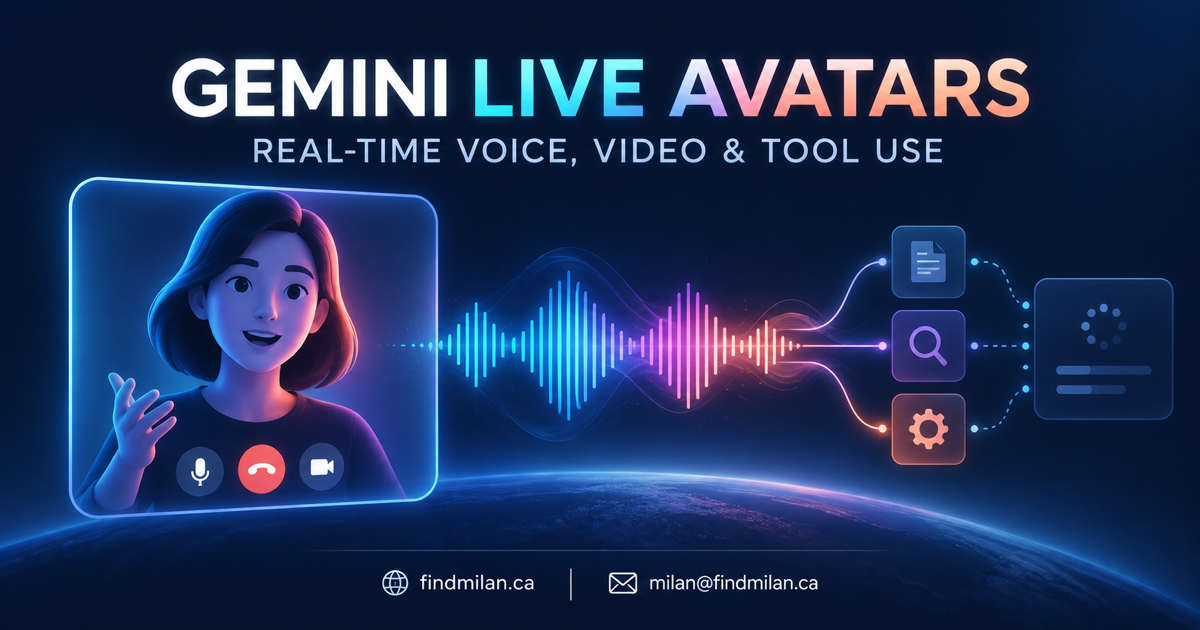
Google announced Gemini 3.8 Live with Live Avatar for Gemini Enterprise on September 24, 2026. The update adds a visual avatar synchronized with real-time speech and video, while asynchronous tool calls can run without stopping the conversation.
The practical change is a richer interface for enterprise voice agents—not a replacement for the application around them. Developers still need to handle consent, tool permissions, accessibility, latency, language coverage, and clear disclosure that the avatar is AI-generated.
What Live Avatar adds to Gemini Live
Google describes Live Avatar as a visual persona that listens, sees, and speaks during a low-latency conversation. Its announcement highlights generated video synchronized with speech, expressive reactions, turn-taking, and the ability to use tools in the background while a conversation continues.
The Gemini Live API documentation describes a stateful WebSocket session with audio, video, and text inputs. It lists gemini-3.8-live as generally available and includes Live Avatar among its capabilities. The generated avatar video is documented as MP4 output.
The model card describes avatar generation as suitable for sessions lasting a few minutes, rather than hours. That makes session duration and graceful reconnection important design constraints for any longer support or coaching workflow.
Availability and customization limits
Google’s launch post says the feature is available in Gemini Enterprise. The API model is listed as generally available in Google Cloud documentation, but product access, regional rollout, quotas, and billing can differ by account and deployment.
Google says organizations can choose from preset avatars and create custom avatars from a reference image. Custom-avatar generation is currently restricted to enterprise allowlisting. That is a meaningful limitation: do not promise a self-serve custom-avatar workflow until Google enables it for the specific project.
A language-support detail developers should test
Google’s launch announcement says the avatar can adapt lip-sync and expression as a conversation moves across 97 languages. Separately, the Live API documentation lists 24 supported conversation languages. These statements may refer to different parts of the system—the avatar’s visual adaptation versus the spoken conversation model—but the distinction is not fully spelled out in the announcement.
For a production product, validate every required language, code-switching pair, voice, avatar, and tool workflow in the actual account. Do not treat the headline language count as proof that every locale has identical speech quality, latency, or feature parity.
Background tools keep the conversation moving
The feature can start a tool call and continue the dialogue while data is retrieved. That may help with an interactive walkthrough or a support conversation where the application needs to fetch approved information without leaving the user in silence.
It also raises the same agent-security requirements as any tool-using system:
- expose only the minimum necessary tools and data;
- separate read actions from writes and transactions;
- validate model-supplied arguments on the server;
- require confirmation before consequential changes;
- show what is happening while a tool runs;
- handle timeouts, duplicate requests, and interrupted sessions safely.
An expressive avatar should never make a result feel more certain or more human-authorized than it is.
Identity, consent, and accessibility
Google says custom avatars can preserve a reference likeness, brand style, or character identity, and that generated audio and video include SynthID watermarking. Watermarking is one transparency measure; it does not replace visible disclosure, consent, or responsible use.
Use a person’s likeness only with documented permission and clear scope for how, where, and for how long it may be used. Give users an obvious way to identify the agent as synthetic, stop the session, and switch to text or a human. Test captions, keyboard interaction, screen-reader support, language switching, and non-video alternatives before launch.
A practical pilot checklist
Before moving beyond a controlled pilot, measure end-to-end response latency, turn interruptions, voice and visual synchronization, tool completion, language-switch behavior, and recovery from network or model errors. Use realistic environments rather than only clean studio demos. Review the current Gemini Live API documentation and your project’s access settings before implementation.
FindMilan’s AI consulting service can help teams scope and evaluate real-time AI experiences. The linked AI Web Awards project is a separate website-quality evaluation product, not a Gemini Live deployment.
Official sources
- Google: Introducing Gemini 3.8 Live with Live Avatar
- Google Cloud: Gemini Live API overview
- Google: Gemini 3.8 Audio (Live) model card
The capabilities and availability statements above are based on Google’s announcement and documentation. Claims about language coverage, security, and experience quality should be validated in the target deployment rather than assumed from a launch page.
Frequently asked questions
What is Gemini 3.8 Live with Live Avatar?
It is Google's real-time Gemini Live experience with an animated visual avatar synchronized to spoken responses. Google says it combines audio and video conversation with asynchronous tool execution, and lists the Gemini 3.8 Live API model as generally available.
Who can use Gemini Live Avatar?
Google announced availability in Gemini Enterprise. Its Live API documentation lists `gemini-3.8-live` as generally available, but custom-avatar creation is currently limited to enterprise allowlisting. Confirm entitlement, region, and current limits in your Google Cloud project.
Does Live Avatar support 97 languages?
Google's launch post says avatar lip-sync and expressions can adapt during language transitions across 97 languages. The separate Live API documentation lists 24 supported conversation languages. These statements may describe different layers, so developers should test the exact language and model combinations they need.
How long can a Live Avatar session run?
Google's model card says avatar generation is intended for sessions lasting a few minutes, not hours. Confirm current session limits and behavior in the target product before designing a long-running experience.
Can a Gemini Live Avatar use tools while speaking?
Google says asynchronous tool calls can run while dialogue continues. An application still needs to authorize each tool independently, validate arguments and results, and require confirmation for consequential actions.
Can a business create a custom Live Avatar?
Google says custom avatar creation from a reference image is available only through enterprise allowlisting. Teams should use only likenesses they have permission to use, document consent and usage rights, and clearly disclose AI-generated media.