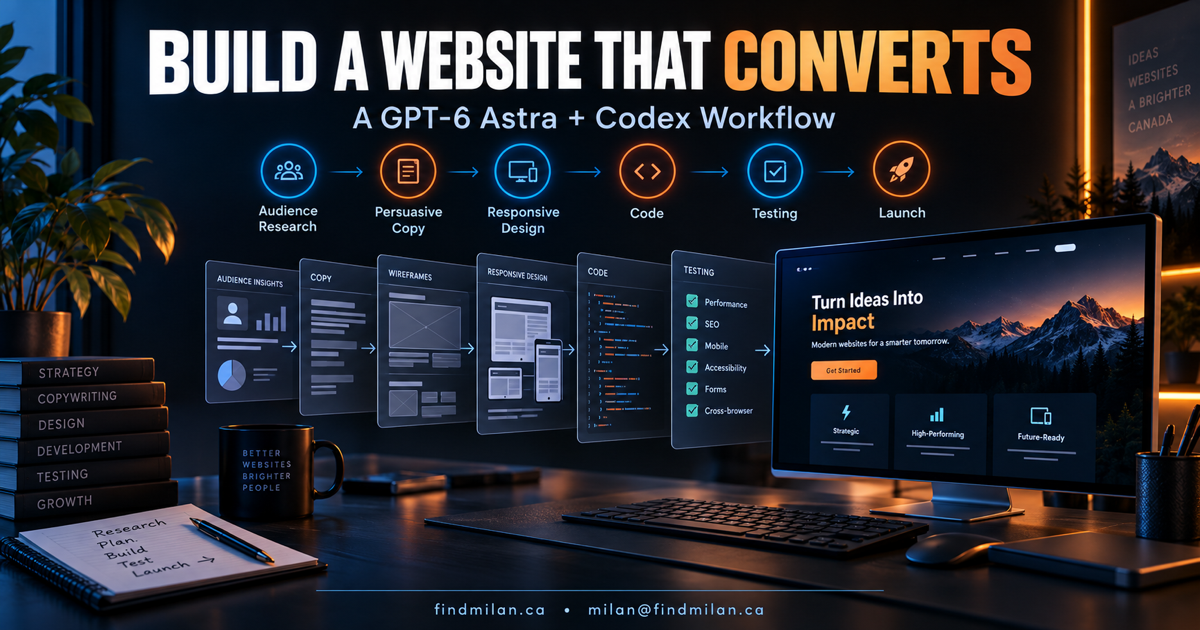
GPT-6 Astra and Codex can compress a website project from weeks of disconnected handoffs into a much tighter research, copy, design, development, and testing loop. The winning strategy is not asking AI for a beautiful page in one prompt. It is using AI inside a disciplined conversion workflow and keeping human judgment at every important decision.
A conversion-focused website must deliver the right message to the right audience, make the next action obvious, load quickly on mobile, and produce measurable business results. Design supports that system; it does not replace it.
This guide shows how I approach that process using GPT-6 Astra for complex reasoning and Codex for implementation, iteration, and verification.
The workflow at a glance
| Stage | Core question | AI can accelerate | Human must decide |
|---|---|---|---|
| Research | Who is this page for? | Synthesize interviews, reviews, analytics, and competitors | Which evidence is reliable |
| Offer | Why should they act? | Organize outcomes, objections, and proof | The real promise and commercial terms |
| Copy | What must the page say? | Draft structures, variants, and clarity edits | Voice, accuracy, emotion, and claims |
| Design | How should it communicate? | Explore layouts and translate references | Taste, hierarchy, brand, and trade-offs |
| Development | How will it work? | Build components, integrations, and tests | Architecture, risk, and acceptance criteria |
| Verification | Does it work for real users? | Run checks and inspect failures | Whether evidence is sufficient to launch |
| Improvement | What should change next? | Analyze patterns and propose experiments | Priorities and business decisions |
The sequence protects the project from a common failure: polishing the wrong message for the wrong customer.
1. Start with the customer, not the interface
Before opening a design tool, gather evidence about the people who should act on the page.
Useful inputs include:
- customer interviews and sales-call notes;
- support questions and objections;
- search queries and on-site search terms;
- analytics from current pages and funnels;
- reviews of your product and alternatives;
- win/loss notes and reasons prospects delay;
- language customers use to describe the problem;
- the operational reality of delivering the service.
GPT-6 Astra can work across long documents and multi-step research tasks. The official GPT-6 Astra model documentation describes support for complex reasoning, research, coding, computer use, and large-context work. That makes it useful for organizing evidence and finding repeated themes.
It should not manufacture customer insight. Label assumptions separately from observed evidence. If five customer interviews contradict a confident AI summary, the interviews win.
Create a concise research brief containing:
- the highest-priority audience;
- the job they are trying to complete;
- the cost of the current problem;
- the outcome they want;
- their top objections and risks;
- the language they already use;
- proof the business can support;
- the single next action the page should drive.
2. Define an offer the page can explain
A landing page cannot rescue an unclear offer. Write a one-sentence offer before writing the headline:
We help [specific audience] achieve [valuable outcome] through [credible method], with [important constraint or advantage].
Then pressure-test it:
- Is the audience specific enough to recognize themselves?
- Is the outcome concrete and meaningful?
- Can the business prove the claim?
- Does the method create a believable reason to choose this approach?
- Are price, scope, timing, and risk understandable?
- Is the call to action appropriate for the buyer’s level of intent?
Avoid unsupported revenue promises. A website can improve clarity, speed, lead quality, and the path to action, but it cannot guarantee sales independently of demand, traffic, pricing, reputation, and delivery.
3. Write the conversion path before the visual design
The page should tell one connected story. A dependable structure is:
- Hero: what the offer is, who it is for, the primary outcome, and one clear action.
- Recognition: the problem in the customer’s language.
- Outcome: what changes after the problem is solved.
- Method: how the service or product produces that outcome.
- Proof: relevant examples, results, credentials, or demonstrations.
- Objection handling: fit, process, timing, risk, and alternatives.
- Offer details: what is included and what happens next.
- Call to action: a low-friction next step.
- FAQ: concise answers to genuine purchase questions.
Every section should either help the visitor understand, trust, or act. If it does none of those, it is likely decoration.
The five-second clarity test
A new visitor should be able to answer these questions almost immediately:
- What is this?
- Is it for someone like me?
- What outcome does it offer?
- Why should I trust it?
- Where do I click next?
Run this test on a phone as well as a desktop. Mobile visitors should not need to dismiss animations, decode vague slogans, or scroll through a full screen before learning what the company does.
4. Use GPT-6 Astra as a strategist and editor
Rather than asking for final copy in one step, give GPT-6 Astra bounded roles across the process.
Research synthesis
Ask it to group evidence by goals, pains, objections, triggers, and exact customer language. Require citations back to the provided material and a separate list of unsupported assumptions.
Message strategy
Ask for several positioning options with the audience, promise, mechanism, proof requirement, likely objection, and risk of each option. Choose the direction based on evidence, not the most dramatic wording.
Page architecture
Provide the chosen strategy and ask for a section-by-section narrative. Each section should state its purpose, the customer question it answers, the evidence required, and its connection to the next section.
Copy review
Evaluate copy against six useful qualities:
- Attention: does the opening earn attention without clickbait?
- Relevance: does the customer recognize their situation?
- Emotion: does the language reflect the real stakes?
- Contrast: is the new approach meaningfully different?
- Specificity: are claims tangible rather than vague?
- Continuity: does each sentence make the next one easier to read?
Then edit manually. Check every fact, remove generic AI phrases, align the voice with the brand, and ensure the emotional intensity matches the decision being made.
5. Brief Codex with the complete page contract
Codex performs best when it receives more than a visual request. Give it the working copy and the implementation context:
- repository and framework;
- routes and components it may change;
- final page copy and content hierarchy;
- design system, typography, colours, and reusable components;
- original images, video, icons, and other assets;
- desktop and mobile references;
- conversion action and destination;
- accessibility requirements;
- performance budget;
- SEO metadata and structured-data requirements;
- analytics events;
- browser and build tests;
- prohibited changes and deployment boundary.
OpenAI’s model guidance for GPT-6 Astra describes support for multi-step workflows across code, browsers, and professional software. The workflow still needs an explicit contract. The model should know what “done” means before it starts editing.
Ask Codex for a functional first pass, not a supposedly final masterpiece. The first implementation is a workbench where content, responsive behaviour, and real assets can be evaluated together.
6. Design section by section
AI-generated interfaces improve quickly when feedback is concrete and local.
Instead of saying “make it premium,” describe the issue:
- the headline wraps into four lines on a 390-pixel screen;
- the CTA is visually weaker than the secondary link;
- the proof appears too late;
- the image reduces text contrast;
- the animation delays comprehension;
- the pricing comparison is difficult to scan;
- the mobile layout causes horizontal overflow.
Use your own sketches, wireframes, brand references, and screenshots when you have permission to use them. Ask Codex to infer layout relationships—not to copy another company’s identity or assets.
Iterate in this order:
- information hierarchy;
- responsive layout;
- typography and spacing;
- colour and contrast;
- original imagery and proof;
- interactions and motion;
- finishing details.
Motion should explain state, hierarchy, or progress. It should not block scrolling or hide essential information from users who prefer reduced motion.
7. Build mobile performance into the acceptance criteria
Fast mobile rendering is part of conversion design. Define measurable requirements before implementation:
- no horizontal overflow at common phone widths;
- readable body text without zooming;
- touch targets with adequate size and spacing;
- stable layout while fonts and media load;
- responsive images with correct dimensions;
- limited client-side JavaScript;
- deferred non-critical embeds and third-party scripts;
- keyboard-visible focus states;
- proper headings, landmarks, labels, and alternative text;
- reduced-motion support;
- forms that show useful validation and recovery messages.
Test real mid-range mobile conditions, not only a wide desktop with a narrow browser window.
8. Instrument the conversion before launch
Define the primary conversion and the events that explain it. For a service website, that may include:
- primary CTA click;
- booking page view;
- booking completion;
- phone or email action;
- qualified form submission;
- form error;
- case-study engagement;
- pricing or process section view.
Do not treat a button click as a completed sale or booking. Track the downstream event that represents the real business outcome, and validate it with a genuine test after deployment.
Record a baseline where possible. After launch, review qualified conversion rate, completion rate, acquisition source, device differences, performance, form failures, and lead quality. Traffic without the intended outcome is not a conversion win.
9. Verify before calling the website finished
The acceptance check should cover:
| Area | Verification |
|---|---|
| Message | A new visitor can explain the offer and audience |
| Content | Claims, prices, links, and proof are accurate |
| Mobile | Key breakpoints have no clipping, overlap, or overflow |
| Accessibility | Keyboard, focus, labels, contrast, headings, and reduced motion work |
| Performance | Production-like pages meet the agreed budget |
| Forms | Success, failure, validation, and spam handling are tested |
| SEO | Canonical, title, description, indexability, sitemap, and schema are valid |
| Analytics | A real conversion produces the expected event once |
| Operations | Ownership, backups, monitoring, and rollback are documented |
A build command passing is useful evidence. It is not proof that the deployed form delivers a lead or that the mobile page is usable.
What AI changes—and what it does not
GPT-6 Astra and Codex make research synthesis, drafting, implementation, iteration, and verification faster. They also make superficial website production easier for everyone.
That means the durable advantage moves toward things AI cannot infer from a generic prompt:
- direct customer knowledge;
- a differentiated and deliverable offer;
- credible proof;
- strong taste and clear decisions;
- original brand assets;
- technical quality;
- disciplined experimentation;
- dependable operations after launch.
The best AI website workflow is not one-shot generation. It is a shorter feedback loop between evidence, judgment, implementation, and real results.
Build your conversion-focused website with Milan
I design and build fast, responsive websites for service businesses, startups, and product teams. My website development services combine customer-focused structure, custom design, technical SEO, accessibility, analytics, integrations, and production verification.
For teams that want AI inside their broader operations, I also provide AI consulting and custom development, including agent workflows, evaluation, automation, and secure implementation. You can review AI Web Awards as an example of my product work or book a free strategy call to discuss your website.
Official sources
Frequently asked questions
Can GPT-6 Astra build a complete website?
GPT-6 Astra can support research, content, design reasoning, coding, browser work, and multi-step implementation. A dependable production website still needs clear requirements, original assets, human review, testing, analytics, security, accessibility, and deployment controls.
Should website design come before the copy?
Usually no. First define the audience, offer, proof, objections, and primary action. Build the page structure and copy around those decisions, then use visual design to improve comprehension, trust, and action rather than forcing content into a decorative template.
What makes an AI-generated website convert?
The same fundamentals as any effective website: a clear audience, relevant offer, specific message, credible proof, low-friction action, fast mobile performance, and ongoing testing. AI can accelerate the work, but it cannot replace customer evidence or measurement.
How should I prompt Codex to build a landing page?
Provide the audience, offer, page copy, required sections, existing design system, assets, conversion action, accessibility and performance requirements, target devices, analytics events, files it may change, and the exact browser journeys and build checks required for acceptance.
How do I know whether the new website is working?
Define the primary conversion and supporting events before launch, validate analytics with a real test, monitor qualified conversion rate and completion errors, and compare changes through controlled experiments or clear before-and-after periods. Visual quality alone is not evidence.