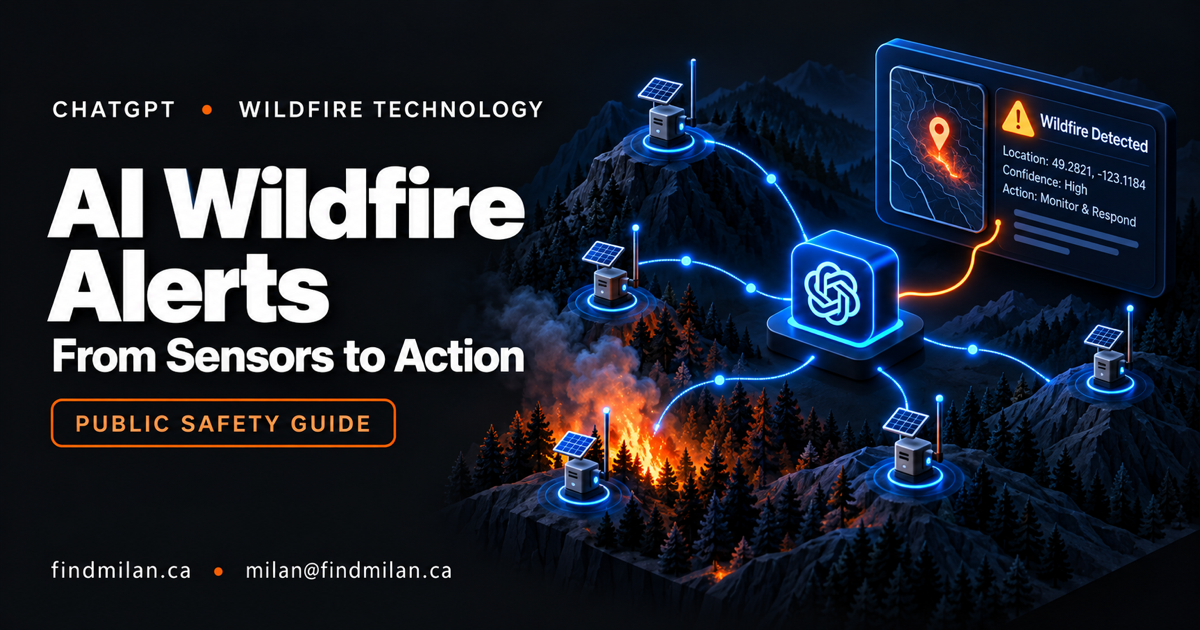
OpenAI released a short video on September 14, 2026 showing a wildfire sensor network connected to ChatGPT. The physical sensors identify possible ignition conditions, while ChatGPT turns complicated readings into understandable answers about the alert, the evidence, and the reported GPS location.
The distinction matters: ChatGPT is not the wildfire detector in this system. Detection begins with purpose-built field hardware and validated sensor logic. The conversational AI layer makes the resulting information easier to understand and query. In a high-stakes setting, that layer should support trained people and established emergency procedures—not replace them.
Source note: This article analyzes the system demonstrated in OpenAI’s official “Detecting wildfires with ChatGPT” video and public deployment information from the City of Laguna Beach. The video does not publish a complete technical architecture, model specification, accuracy study, or emergency-response protocol. Where this guide discusses production design, it presents recommended engineering practices rather than undisclosed facts about the demonstrated system.
ChatGPT wildfire monitoring at a glance
| Layer | Responsibility |
|---|---|
| Field sensors | Observe physical conditions and produce measurements |
| Detection logic | Decide whether readings meet a validated alert threshold |
| Location system | Attach sensor identity and GPS coordinates |
| Data platform | Receive, normalize, store, and route telemetry |
| ChatGPT layer | Explain the alert and answer approved questions in plain language |
| Human operators | Validate evidence and follow authorized response procedures |
| Emergency systems | Deliver official notifications and dispatch resources |
OpenAI’s video demonstrates questions such as: What is this alert? Why does the system believe this could be a fire? Where is it located? That conversational interface can reduce the time required to interpret a dense stream of sensor values, especially when an operator is working in the field.
What the wildfire sensors do
Remote terrain is difficult to monitor continuously. A distributed sensor network creates observation points across ridges, canyons, open space, and other high-risk locations. Each unit can collect environmental readings and report them to a central platform.
In the OpenAI video, the field system detects an ignition event when it begins and associates the event with a location. The long-term goal shown is a larger network spread across vulnerable terrain so that a possible fire can be identified before it grows into a much harder incident.
The City of Laguna Beach announced in August 2026 that it selected the SensoRy AI wildfire risk-management sensor network for deployment across high-risk open space and selected inner canyons. The city said the network would provide rapid notifications to first responders and connect with a broader regional network around the wildland-urban interface.
That public deployment is stronger evidence than a laboratory demonstration alone. It also raises the standard for reliability: equipment placed in remote terrain must handle power limits, weather, damaged connectivity, sensor drift, false signals, maintenance, and incomplete coverage.
What ChatGPT adds to the system
Sensor platforms can produce technically correct information that is still difficult to use quickly. A reading may include device identifiers, timestamps, thresholds, confidence values, coordinates, recent trends, and relationships with nearby units.
A carefully constrained ChatGPT layer can transform that structured evidence into answers such as:
- which sensor produced the alert;
- where the sensor is located;
- which readings crossed a threshold;
- whether nearby sensors report related changes;
- how recent the evidence is;
- what information is missing;
- which approved operating procedure applies next.
The model should answer from the current sensor record and controlled documentation, not from general intuition. Every factual statement should be traceable to the underlying telemetry, system rule, map record, or approved response guide.
A safe architecture for conversational sensor data
The most dependable design keeps deterministic safety logic separate from generative explanation.
1. Ingest and validate telemetry
Every event should include a sensor identity, timestamp, location, measurement units, device health, and integrity checks. The platform should reject malformed records, detect impossible values, and recognize stale or duplicated events.
2. Apply validated detection rules
Purpose-built rules or independently evaluated detection models determine whether the readings indicate a possible event. These rules should be versioned, tested, and approved by domain specialists.
ChatGPT should not quietly invent or change the threshold. The alert decision and the conversational description must remain separate records.
3. Build an evidence package
When a rule triggers, the platform assembles only the evidence required for review:
- the latest readings and recent trend;
- the sensor’s verified coordinates;
- relevant nearby sensors;
- device-health information;
- threshold or model version;
- supporting images or weather data, where available and authorized.
This package becomes the source of truth for the explanation layer.
4. Generate a grounded explanation
The language model receives the evidence package and an approved response format. It can summarize why the alert exists, state the location, distinguish confirmed facts from uncertainty, and answer questions using only the supplied record.
If the evidence is incomplete, the correct response is to say so. A fluent answer must never be treated as proof that a fire has been confirmed.
5. Require operational verification
Trained staff review the alert using the organization’s existing systems and procedures. Depending on the program, that may include checking cameras, comparing nearby sensors, contacting field personnel, or following an emergency communications protocol.
The AI interface can accelerate interpretation, but authorized emergency services remain responsible for confirmation, public warnings, and dispatch.
Why voice access can help in the field
The video also shows the system being queried by voice. Hands-free interaction can be useful when a person is installing hardware, carrying equipment, wearing gloves, or looking at the terrain instead of a screen.
A voice workflow still needs careful design. The system should read back critical coordinates, distinguish a question from an action, confirm the intended sensor or incident, and require explicit approval before sending messages or changing operational state. Background noise and speech-recognition mistakes must be expected failure modes.
For public-safety use, the interface should provide the same evidence visually whenever possible. Voice is an access method, not the sole audit trail.
The most important safety controls
Any AI-assisted detection workflow should be designed around failure, not only the successful demo.
Keep the source data visible
Operators need access to the original reading, timestamp, location, device health, and detection rule. An AI summary should never hide the evidence behind a confident paragraph.
Separate advisory and authoritative actions
Use clear labels such as “sensor alert,” “AI-generated explanation,” “operator-reviewed,” and “confirmed incident.” These states should not be visually interchangeable.
Design for false positives and false negatives
Teams should measure missed events, unnecessary alerts, delayed alerts, location errors, and explanation errors. Accuracy must be evaluated across weather, terrain, seasons, hardware versions, and connectivity conditions.
Preserve independent communication paths
If the AI service or data connection is unavailable, essential sensor alerts should still reach the appropriate monitoring system. A generative interface should not become a single point of failure.
Log every consequential step
The system should record the received evidence, rule version, generated explanation, operator review, notification destination, and final outcome. Logs make incident review and improvement possible.
Protect sensitive infrastructure data
Exact device locations, network configuration, credentials, and operational procedures may be sensitive. Apply role-based access, encryption, secret isolation, and restricted retention before connecting any AI model.
Where this pattern applies beyond wildfires
The larger product lesson is about connecting physical systems to understandable, controlled AI interfaces. The same architecture can support:
- industrial equipment monitoring;
- building temperature, energy, and air-quality systems;
- agricultural soil and irrigation sensors;
- water-level and flood monitoring;
- fleet and logistics telemetry;
- remote infrastructure maintenance;
- environmental and conservation programs.
In each case, the sensor and validated domain logic remain authoritative. The AI layer helps people investigate, summarize, and navigate the evidence.
How to pilot an AI sensor assistant
A responsible pilot can begin without allowing the model to trigger external actions.
- Select one existing sensor workflow with known operators and historical data.
- Document the current alert rules and response procedure.
- Give the AI read-only access to a sanitized evidence package.
- Require citations back to individual readings and rule versions.
- Test normal events, false alarms, missing data, stale sensors, and outages.
- Compare the explanation with an expert-reviewed answer.
- Measure time saved, factual errors, uncertainty handling, and operator trust.
- Add carefully scoped actions only after the read-only workflow is reliable.
The first production goal should be better understanding, not autonomous emergency authority.
How I can help with AI and sensor workflows
I provide AI consulting and custom AI development for organizations turning complex operational data into secure, usable AI systems. That includes sensor-data architecture, grounded assistants, retrieval, evaluation, permissions, audit trails, and human approval workflows.
I can also build the surrounding system through workflow automation, SaaS product engineering, website development, and mobile app development. The XReporter operations and reporting system demonstrates how structured data and operational reporting can be combined in a focused product.
Book a free strategy call if you want to explore an AI interface for IoT data, operational monitoring, environmental systems, or another high-context workflow.
Official sources
Frequently asked questions
Can ChatGPT detect a wildfire by itself?
No. In this example, physical field sensors detect environmental signals and produce the underlying data. ChatGPT helps translate that data into understandable explanations, locations, and responses. Detection, validation, and emergency action still require purpose-built systems and responsible human oversight.
How can ChatGPT help with wildfire sensor data?
A controlled AI layer can explain an alert, identify the reported GPS location, summarize supporting readings, answer approved questions, and present technical data in language that operators or residents can understand.
Should an AI-generated wildfire alert be trusted automatically?
No. Public-safety systems need deterministic thresholds, independent validation, confidence indicators, audit logs, fail-safe communications, trained operator review, and direct integration with authorized emergency procedures. A language model should not be the sole decision-maker.
What is needed to build an AI sensor-monitoring system?
The system needs reliable sensors, secure connectivity, data ingestion, validated rules, location mapping, an AI explanation layer, role-based access, human approval paths, monitoring, incident logs, and extensive testing under normal and failure conditions.
Can the same architecture work outside wildfire monitoring?
Yes. Similar patterns can help explain industrial equipment telemetry, building systems, environmental monitoring, logistics events, agricultural sensors, and other IoT data, provided that domain-specific validation and safety controls remain authoritative.