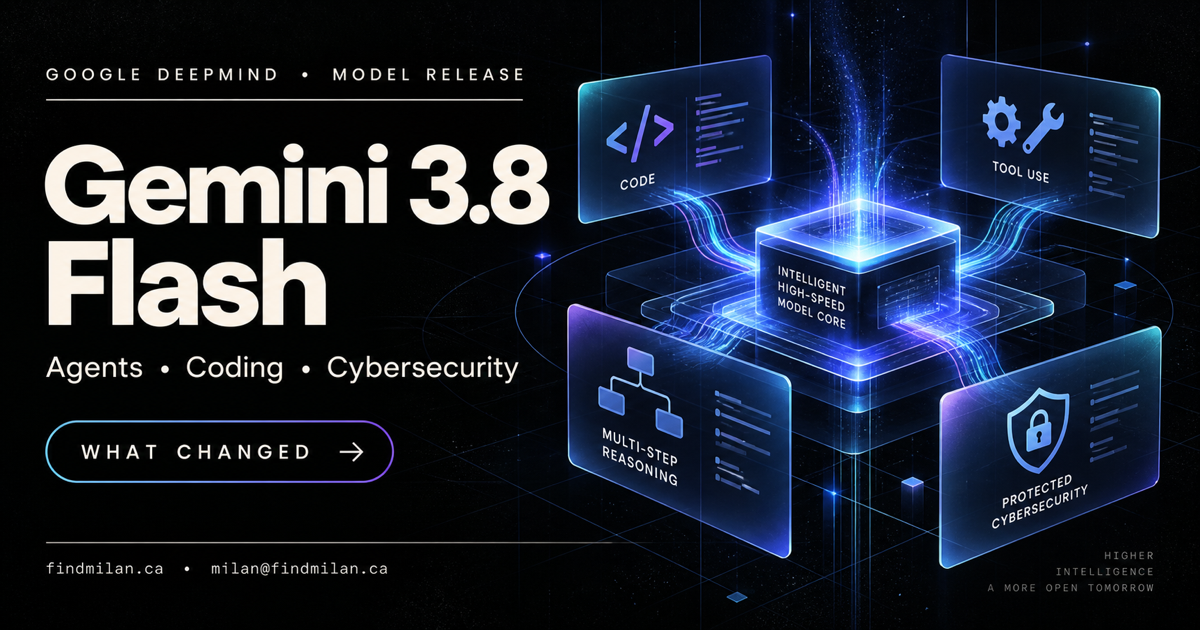
Google introduced Gemini 3.8 Flash and Gemini 3.8 Flash Cyber on September 2, 2026. Gemini 3.8 Flash is the broadly available model for coding, autonomous agents, tool use, and complex reasoning. Flash Cyber is a specialized defensive-security version available only to trusted organizations through Google’s Fairwind Program.
The release is important because Google is offering its stronger Flash model at the previous generation’s introductory price while positioning it for longer, more autonomous work. That combination could improve the cost of production AI agents—but Google also warns that the model may perform additional reasoning steps and use more tokens on difficult tasks.
Source note: This guide reflects Google’s official announcement and developer information available on September 13, 2026. Prices, model identifiers, access rules, benchmarks, and safeguards can change. Confirm the current Gemini documentation before deploying either model.
Gemini 3.8 Flash and Flash Cyber at a glance
| Detail | Gemini 3.8 Flash | Gemini 3.8 Flash Cyber |
|---|---|---|
| Primary purpose | Coding, agents, tools, and multi-step reasoning | Defensive vulnerability discovery and patching |
| Availability | Developers, enterprises, and eligible consumers | Trusted defenders through the Fairwind Program |
| Underlying intelligence | Gemini 3.8 foundation | Same foundation with specialized cyber training and controls |
| API price | Introductory $0.75 input / $3.75 output per million tokens | Access-dependent |
| Safety profile | General deployment safeguards | More permissive cyber mitigations with restricted access |
The two releases are related but not interchangeable. Flash is the practical choice for general application development. Flash Cyber is intended for organizations with a legitimate defensive-security requirement and the controls needed to operate a more capable cyber model.
Gemini 3.8 Flash API pricing
Google currently lists Gemini 3.8 Flash at:
- $0.75 per million input tokens;
- $3.75 per million output tokens.
That introductory pricing is scheduled to expire on December 31, 2026. Starting January 1, 2027, Google says the price will become:
- $1.50 per million input tokens;
- $7.50 per million output tokens.
The listed price is only one part of an agent’s total cost. A production calculation should include retries, longer reasoning traces, tool calls, search, file storage, sandbox compute, observability, human review, and failed runs.
Gemini 3.8 may work harder than 3.7 on complex tasks. More reasoning can improve task completion while also increasing token consumption. Teams should measure cost per accepted outcome, not merely the price of one million tokens.
What changed for coding and AI agents
Google describes Gemini 3.8 Flash as its strongest reasoning and coding model so far, with improvements in long-horizon software engineering, specialized professional analysis, and autonomous tool use.
The practical improvements Google highlights include:
- stronger end-to-end work on complex software tasks;
- more iterative tool calls and reasoning on difficult problems;
- better performance across finance and legal agent evaluations;
- support for agent-first development in Google Antigravity;
- availability through the Gemini API and Google AI Studio.
Google reports a score of 54.9% on HLE-Verified and says the model performs strongly on its cited long-horizon software-engineering, finance-agent, and legal-agent evaluations. These are vendor-reported results. They do not prove that the model will understand a private codebase, follow an organization’s approval rules, or safely operate production systems.
For a real evaluation, test whether the model can:
- identify the correct repository, account, tenant, and environment;
- distinguish instructions from untrusted webpage or document content;
- recover safely after tool, dependency, or network failures;
- respect read-only and approval boundaries;
- verify the final downstream outcome rather than stopping at an intermediate success.
Where Gemini 3.8 Flash is available
Google says developers can access Gemini 3.8 Flash through the Gemini API and Google AI Studio. It also points developers to Google Antigravity for agent workflows, Android Studio for application development, and Stitch for generating user interfaces.
Enterprise access is available through Gemini Enterprise. For consumers, Google lists availability for Google AI Pro and Ultra subscribers across the Gemini app, AI Mode in Google Search, and Gemini in Google Sheets.
Access can vary by region, product, account type, and rollout stage. Verify the model is available in the exact project and location that will run the workload before planning a migration.
What Gemini 3.8 Flash Cyber does
Gemini 3.8 Flash Cyber is designed for defensive cybersecurity. Google emphasizes two core capabilities:
- autonomous vulnerability discovery across complex codebases;
- generating and validating patches for identified vulnerabilities.
Google reports that the model exceeds a 70% success rate on an internal vulnerability-discovery benchmark spanning 20 programming languages. It also reports 47.2% pass@1 on the external CWE-Bench patching evaluation, compared with 47.8% for a cited larger frontier model.
For real-world testing, Google says its Chrome Security team obtained 2.6 times more correct vulnerability patches than with the best larger commercial models it evaluated. It also reports that a Google Cloud vulnerability research team found a critical foundational vulnerability in less than two hours.
These figures are encouraging, but they remain vendor claims tied to particular benchmarks and internal workflows. Security teams should independently validate findings, reproduce vulnerabilities, review patches, and keep deployment approval separate from model output.
Why Flash Cyber access is restricted
A model that can find and patch vulnerabilities can also expose sensitive attack paths. Google says Flash Cyber uses a more permissive cybersecurity safeguard profile than the general model, so it is not offered as an unrestricted public endpoint.
The Fairwind Program prioritizes access for:
- trusted government authorities;
- critical-infrastructure operators;
- software maintainers with legitimate defensive needs.
Eligible organizations still need strict operating controls. Use isolated environments, narrow repository access, restricted network egress, protected secrets, complete audit logs, and human approval before modifying or deploying production code.
Safety and prompt-injection risks
Google says the general Gemini 3.8 Flash model includes protections for chemical, biological, radiological, nuclear, and offensive-cyber misuse. It also reports improved prompt-injection robustness based on a Gray Swan evaluation.
No benchmark removes the application developer’s responsibility. An agent can encounter malicious instructions in websites, repositories, tickets, emails, documents, and tool output. Treat retrieved content as data—not as authority to change the task or expand permissions.
Production agents should have:
- allowlisted tools and destinations;
- separate read and write credentials;
- short-lived, least-privilege access;
- explicit approval for consequential actions;
- schema validation for tool arguments and results;
- deterministic tests and rollback criteria;
- monitoring for unusual token, tool, or network activity.
A responsible migration plan
Do not replace Gemini 3.7 Flash or another production model based only on Google’s benchmark charts.
1. Build a representative evaluation set
Use real tasks covering typical work, hard edge cases, tool failures, sensitive inputs, prompt injection, and requests that should be refused or escalated.
2. Compare accepted outcomes
Measure task completion, reviewer corrections, latency, total tokens, retries, tool costs, and time saved. Track results at different effort levels because the highest setting may not deliver the best business value.
3. Test the entire agent system
Evaluate permissions, sandboxing, network access, secret handling, interruption, recovery, duplicate execution, observability, and final acceptance checks—not only the model response.
4. Release gradually
Start with internal users or a small traffic percentage. Keep the previous model route available, define rollback thresholds, and review the pricing change scheduled for January 2027 before estimating long-term cost.
How I can help with Gemini and AI agents
I provide AI consulting and custom AI development for teams comparing Gemini, OpenAI, Anthropic, and other model routes; designing evaluations; securing tool use; and building measurable production agents.
I can also deliver the full product through SaaS product engineering, workflow automation, website development, and mobile app development. The AI Web Awards platform is one example of turning AI capabilities into a focused user experience.
Book a free strategy call to plan a small Gemini 3.8 pilot with clear permissions, cost tracking, and acceptance criteria.
Official sources
Frequently asked questions
What is Gemini 3.8 Flash?
Gemini 3.8 Flash is Google's general-purpose model for agentic workflows, coding, tool use, and multi-step reasoning. Google launched it on September 2, 2026 as a higher-capability successor to Gemini 3.7 Flash.
How much does Gemini 3.8 Flash cost?
Google lists introductory API pricing of $0.75 per million input tokens and $3.75 per million output tokens through December 31, 2026. It says pricing will change to $1.50 input and $7.50 output per million tokens on January 1, 2027.
What is Gemini 3.8 Flash Cyber?
Gemini 3.8 Flash Cyber is a specialized defensive-security version focused on vulnerability discovery and automated patching. It uses the same underlying intelligence with different safeguards and restricted access.
Can anyone access Gemini 3.8 Flash Cyber?
No. Google says Flash Cyber is available through its Fairwind Program to trusted government authorities, critical-infrastructure operators, and software maintainers that qualify for access.
Should teams immediately replace Gemini 3.7 Flash?
No. Gemini 3.8 can use more reasoning steps and tokens on complex tasks. Teams should benchmark both models on real workloads, compare accepted outcomes and total costs, and release behind a reversible route.