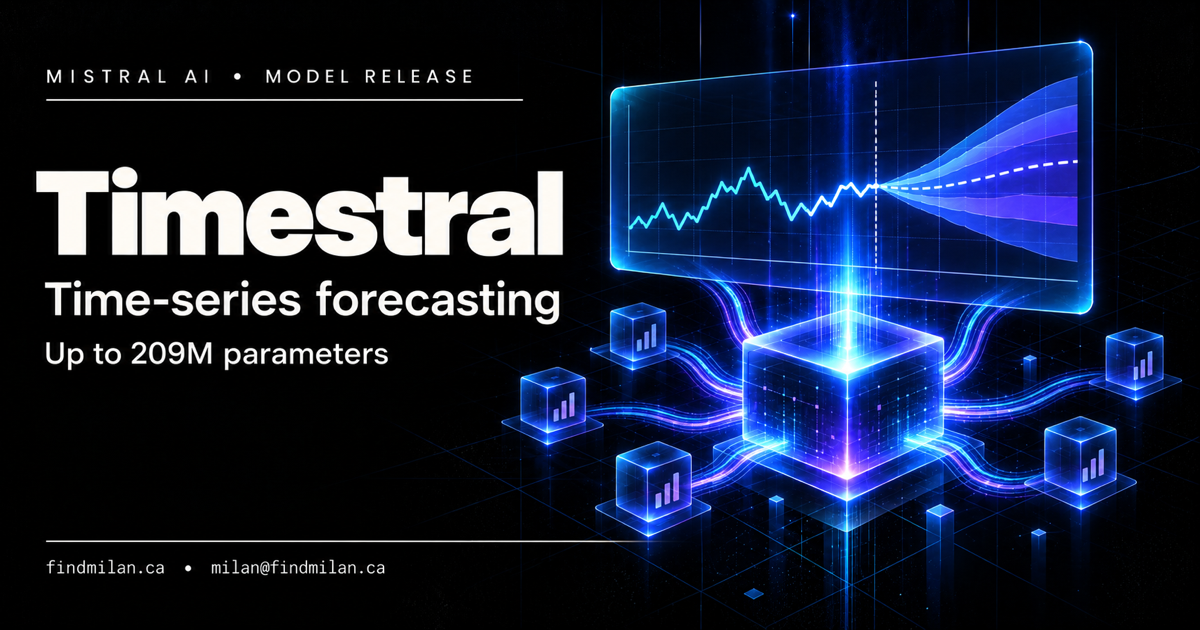
Mistral Timestral gives developers downloadable models for forecasting numerical data, with CPU inference and explicit uncertainty outputs. For teams planning demand, staffing or infrastructure capacity, the useful question is whether it improves a real forecasting workflow—not whether a chatbot can write a convincing explanation of future numbers.
Mistral’s October 15 announcement introduces four model sizes, from 5 million to 209 million parameters. The model documentation labels Timestral 1.0 Public Preview. Download access should not be confused with an unrestricted licence or a generally available paid forecasting API.
What does Timestral actually predict?
Timestral works with observations ordered over time. An application might supply hourly demand or equipment readings and ask for a future forecast. This is a different task from asking a language model to invent the next month’s sales figures.
The official release describes multivariate targets, past-only and known-future covariates, a context of up to 32,768 time steps, and forecasts with 21 quantiles. Time steps are observations at your chosen frequency—not a language model’s token budget.
In plain English, covariates are additional inputs that help explain the series. A calendar known in advance can be a future input; an actual future measurement that would not yet exist cannot honestly be used in a backtest.
Quantiles provide several forecast levels instead of one apparently certain number. They can support risk-aware planning, but their usefulness depends on whether the uncertainty is calibrated on your data.
Downloadable inference, without assuming cloud API access
Mistral links an official inference repository and model collection. The repository documents Python installation and a TimestralForecaster interface for loading a checkpoint and forecasting from arrays or tensors.
A sensible evaluation starts in an isolated Python environment with a pinned code revision and model version. Use a non-sensitive sample first, record input frequency and missing-value handling, then reproduce the result before integrating it with production data.
CPU support may lower the barrier to a pilot, but it does not establish a universal latency or memory requirement. A model download’s size does not include every tensor, activation and dependency needed while it runs. Benchmark the batch size and horizon your application actually needs.
For long horizons, the README describes block-by-block prediction beyond 1,024 steps, feeding predicted medians back into context. My interpretation: evaluate that longer horizon separately rather than assuming short-range accuracy carries forward unchanged.
Code and model weights have different licences
The inference code licence is Apache 2.0. The 209M model weight licence is Modified MIT, with additional conditions.
The checked weight licence excludes authorization where the global consolidated monthly revenue of your company—or employer—exceeds US$20 million in the preceding month. It directs affected users to request a commercial licence from Mistral. It also requires preservation of the attribution and permission notice.
Do not describe the weights as Apache-licensed, unrestricted MIT or automatically free for every business. Check the exact model and revision with whoever owns software and model compliance at your organization. A small implementation team can still work for an employer above the threshold.
How to evaluate the benchmark claims
Mistral reports leading results among pretrained, zero-shot models on GIFT-Eval, TIME and fev-bench. Those are the publisher’s reported evaluations, not tests performed by FindMilan.
The repository’s benchmark notes describe different task and covariate settings. Before comparing a reported score with your own model, align the available inputs, prediction horizon and evaluation metric. Otherwise, you may be comparing different problems.
For a useful pilot:
- Hold out the most recent period and preserve chronological order.
- Compare with a seasonal-naive baseline and the forecasting method already in use.
- Prevent future-data leakage, including revised measurements and covariates unavailable at prediction time.
- Measure error where it matters operationally, not just an average over easy periods.
- Check quantile coverage, missing-data behavior, latency and resource use.
- Repeat across rolling time windows and unusual demand or operating conditions.
These are suggested evaluation steps, not claimed performance improvements. A model can score well publicly and still be a poor fit for a particular organization’s changing data.
Pair forecasts with an agent carefully
A language agent can explain a forecast, retrieve relevant records or draft a plan. Keep the numerical forecast, supporting evidence and proposed action separate.
For example, a forecast might suggest that processing capacity will be tight next week. An agent could summarize the trend and prepare options. That should not automatically authorize infrastructure spending, customer messages or equipment changes. A statistical association is also not proof of the cause of a fault.
A practical next step
Timestral is worth a bounded trial when you already have a forecasting problem, an honest historical test set and a clear decision the result will support. Begin with the smallest useful model and compare evidence before increasing complexity.
I provide AI consulting and workflow automation to connect models with data, evaluation and review controls. The Sociaxo workflow project illustrates the surrounding application work. The goal is a forecast people can inspect and use responsibly—not an impressive number without a decision process.
Frequently asked questions
Is Timestral a chatbot?
No. Timestral is a family of numerical time-series forecasting models. It predicts future values and uncertainty from ordered historical data, rather than generating conversational answers.
Can Timestral run on a CPU?
Mistral documents CPU and GPU inference, with no GPU required. Actual latency and memory use depend on the model, data shape, forecast horizon and hardware; model file size is not total runtime memory.
Are Timestral weights Apache 2.0?
No. The inference repository uses Apache 2.0, while model weights use Modified MIT terms. The checked 209M weight licence restricts use where company or employer consolidated monthly revenue exceeds US$20 million in the preceding month and directs those users to request a commercial licence. Check the exact model revision's terms.
Does Timestral have a verified hosted API price?
This article verifies downloadable weights and inference code, not a hosted forecasting endpoint or a token price. Mistral's model documentation labels Timestral 1.0 Public Preview.