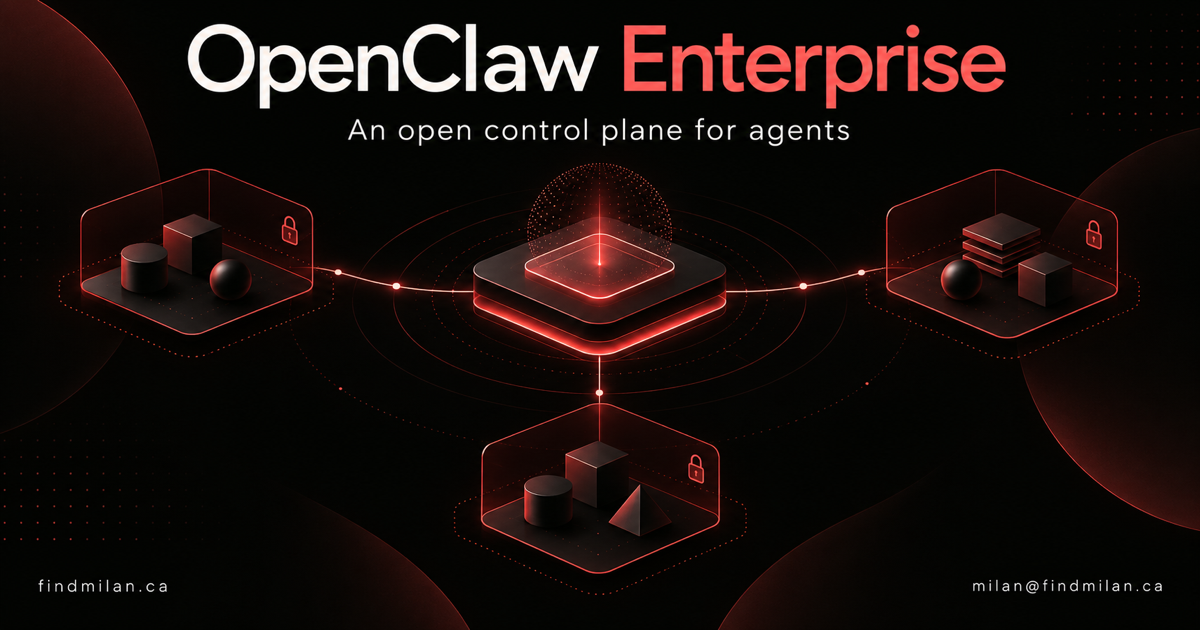
OpenClaw Enterprise is an open-source control plane for teams that want to run persistent agents across users and workloads with centralized governance. It is available to explore now, but the project is still being built toward 1.0. Its maintainers describe the current target as internal pilot workloads, not a blanket production-readiness claim.
That distinction is useful for founders and engineering teams: this is a chance to test how agent deployment, access, auditability, and isolation fit together before giving agents broad access to company systems.
What the new control plane adds
The OpenClaw announcement describes OpenClaw Enterprise (OCE) as a vendor-neutral platform for persistent agents in sensitive environments. The OpenClaw Control Plane (OCC) is intended to add multi-tenancy, governance, and hard boundaries between workloads. The team says the model, harness, and sandbox can be replaced by third-party or internal implementations rather than locked to one stack.
The public repository exposes the control-plane application, resource models, identity and authorization packages, and audit components. That is a concrete starting point for evaluation, but a public codebase is not proof that a particular deployment is secure. Teams still need to inspect configuration, permissions, secrets, logs, and operational recovery in their own environment.
What you can test today
The official getting-started documentation describes a local setup and an installation on an existing Kubernetes cluster. The repository’s quickstart says its default Compose control-plane preview cannot deploy agents. To run the local first-agent walkthrough, use the documented Kubernetes-only development profile; the cluster route has its own install and verification steps. The first-agent walkthrough currently calls for an OpenAI API key with access to the default model or the one you choose.
For a small internal pilot, begin with one low-risk agent and one clearly defined owner. Test how the control plane separates users and workloads, which roles can create or change agents, where credentials are stored, what audit records are produced, and how an operator stops or recovers a failing agent. Keep human approval on consequential actions. A diagram of security boundaries is not a substitute for testing them.
What remains provisional
The announcement says OCE is being developed in the open ahead of a 1.0 release. Its maintainers describe plans for sandboxing, fine-grained permissions, and review layers, while noting that a reference architecture explaining how protections fit together is still forthcoming. Treat those as product direction until you verify the exact behavior in the version and configuration you deploy.
This also is not the same thing as the optional hosted OpenAI Agents API runtime added in OpenClaw 2026.9.7. That runtime is a conversation execution option for the main OpenClaw product; OCE is a separate control-plane project for managing agent deployments. Our 2026.9.7–9.8 release guide covers the former.
A practical evaluation checklist
- Choose a non-sensitive pilot workflow and document the agent’s intended tools, data, owner, and stop conditions.
- Follow the current OCE setup guide and verify that the chosen profile can actually deploy an agent.
- Test tenant separation, role changes, credential rotation, audit trails, and failure recovery with representative users.
- Review the threat model and operational runbook with a security owner before connecting production systems.
- Keep a rollback path and record which project revision and infrastructure configuration you tested.
I help teams evaluate and implement OpenClaw setup and integration, including agent access boundaries, deployment architecture, and operational checks. My agent setup work gives a sense of the systems planning involved; it should not be read as an OCE deployment claim.
Official sources
The feature and maturity statements above reflect the maintainers’ public materials. The pilot checklist is my suggested evaluation process, not a claim that OCE has passed any independent security certification.
Frequently asked questions
What is OpenClaw Enterprise?
OpenClaw Enterprise is an open-source, vendor-neutral control plane for deploying and managing persistent agents with multi-tenancy, governance, and security boundaries.
Is OpenClaw Enterprise ready for production?
The OpenClaw team describes it as pre-1.0 software suitable for internal pilot workloads. Evaluate its security model, operations, and maturity before considering production use.
Can I deploy agents using the default local Compose preview?
The current repository says the default Compose control-plane preview cannot deploy agents. Its documented Kubernetes-only local profile, or an existing Kubernetes cluster, is needed for the agent deployment walkthrough.
Do I need an OpenAI API key?
The current first-agent walkthrough requires an OpenAI API key with access to its default model or a selected override. The platform's broader goal is vendor-neutrality; do not assume the quickstart is credential-free.
Is this a separate product from OpenClaw 2026.9.7?
Yes. OpenClaw Enterprise is a separate, pre-1.0 control-plane project. The 2026.9.7 and 2026.9.8 releases concern the main OpenClaw product and its runtimes and fixes.