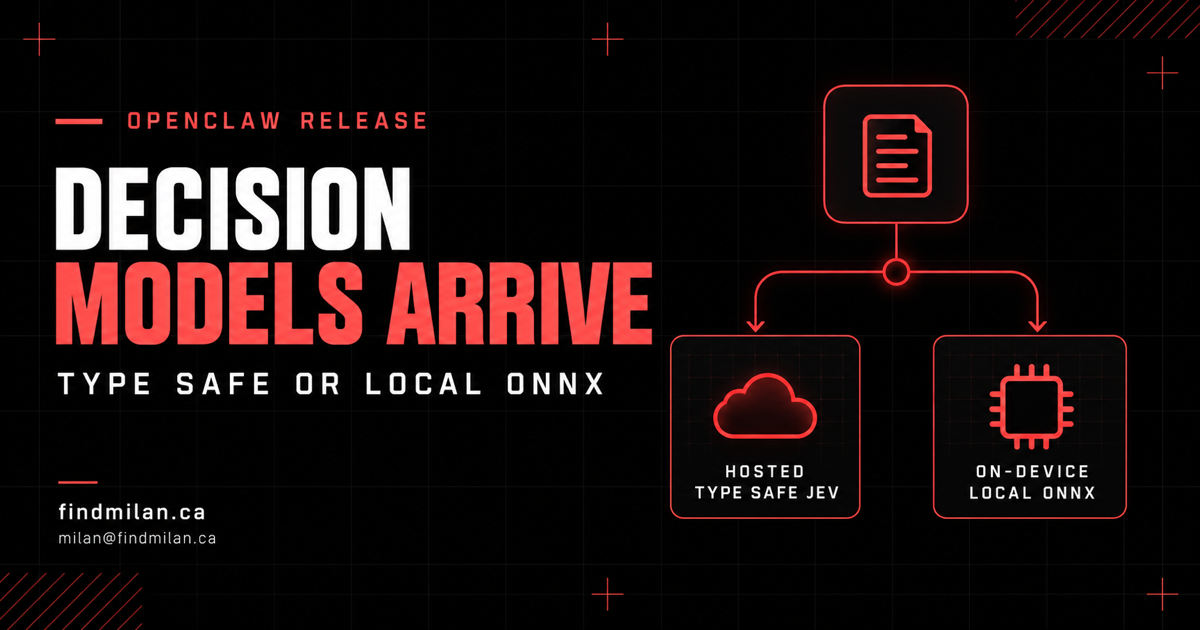
OpenClaw 2026.9.6 adds an optional decision-model role that can evaluate structured questions separately from the model running an agent conversation. The documented paths include the hosted TypeSafe integration and local ONNX classifiers; both remain opt-in.
This separation is useful when an agent needs a bounded judgement—such as whether a prerequisite is met or which of a small set of routes fits—without treating that judgement as a new conversation model. It is not an accuracy guarantee, permission grant, or substitute for application policy.
What changed in OpenClaw 2026.9.6
The release introduces a decision-model picker and a provider-neutral decision_evaluate operation for explicit structured evaluations. It is a different role from the conversational model: choosing it does not change the agent’s normal chat model, add tools, or authorize an action.
The official release describes an optional TypeSafe plugin, which can use hosted Jev or a local System One server, and an optional ONNX classifier plugin for on-device evaluation. OpenClaw’s current plugin guide says the TypeSafe plugin’s first package publication is still pending a supporting release, and identifies a host API requirement. Treat the installation state as time-sensitive and check that guide before attempting to install it.
Hosted TypeSafe and local ONNX are different trade-offs
| Path | What the documentation describes | What to check |
|---|---|---|
| TypeSafe hosted Jev | A remote decision request using selected evidence | Data minimization, TypeSafe account and usage charges, network failure, and the exact evidence sent |
| TypeSafe with local System One | A local server configured for the integration | Loopback configuration, model/runtime resources, version compatibility, and that the service is not exposed to an untrusted network |
| Optional ONNX classifier | Local CPU inference using supported presets or exported models | Model provenance, download integrity, resource use, task-specific evaluation, and fallback behavior |
“Local” needs a precise boundary. OpenClaw’s ONNX documentation says inference can stay on the device once model assets have been prepared; obtaining presets or other assets may involve downloads. Verify the precise behavior and network boundary in the current plugin documentation for the version you deploy.
Where a structured decision can help
A constrained output can make an application easier to reason about than free-form text when the question is genuinely explicit: is a required field present, which supported route should be attempted, or does a case meet a defined score threshold? OpenClaw’s provider-neutral operation is intended for this sort of state, boolean, choice, and score evaluation.
Keep the decision narrow. A model should not decide its own authority, reinterpret security policy, or approve a high-impact action solely because it returned a confident-looking value. Your application should validate the returned type and allowed values, enforce policy independently, and fail closed when the result is absent, malformed, or unavailable.
Practical rollout checks
Before enabling a decision model, test representative positive, negative, ambiguous, adversarial, and out-of-scope examples. Measure false accepts and false rejects separately. Include timeouts, malformed responses, provider outages, and cases where the evidence is incomplete.
For hosted evaluation, send only the evidence required for the decision and review applicable data terms and costs. For local evaluation, pin model artifacts, record their source and version, and check runtime resource use. In either case, preserve a deterministic non-model policy boundary for access control and consequential operations.
This is a new capability in the 2026.9.6 release series, not a reason to combine unrelated adjacent patch notes into a single feature claim. For implementation planning, see our OpenClaw setup and integration service and agent setup project. Our separate TypeSafe Jev and System One overview covers the product itself; this article focuses on its optional OpenClaw integration.
Official sources
- OpenClaw 2026.9.6 release notes
- OpenClaw decision models concept guide
- OpenClaw TypeSafe plugin guide
- OpenClaw ONNX plugin guide
The capability and configuration details above summarize OpenClaw’s own release and documentation. TypeSafe’s hosted service, local inference, package availability, and model behavior have separate dependencies; verify them in your environment before routing production decisions.
Frequently asked questions
What are decision models in OpenClaw 2026.9.6?
Decision models are an optional, separate model role for structured evaluations such as state checks, booleans, choices, and scores. They are distinct from the model that conducts the conversation and do not themselves grant additional tools or permissions.
Does OpenClaw 2026.9.6 require TypeSafe?
No. The TypeSafe integration is optional and disabled by default. The release documentation also describes an optional local ONNX classifier path; neither path is automatically enabled.
Is the TypeSafe OpenClaw plugin available to install from npm now?
The OpenClaw plugin guide currently says first publication is pending a supporting release. The release documentation describes the integration, but operators should confirm package publication and the required host API version before planning installation.
Does a hosted TypeSafe decision send all OpenClaw conversation history?
OpenClaw's documentation says the integration sends only the selected evidence needed for a decision request. Review the exact evidence configured for each decision and TypeSafe's current data terms before enabling a hosted model.
Are decision-model outputs guaranteed to be correct?
No. A typed choice, score, or probability is evidence for an application to consider, not a correctness guarantee or authorization to act. Validate it against representative cases and retain ordinary policy checks and human review for consequential actions.