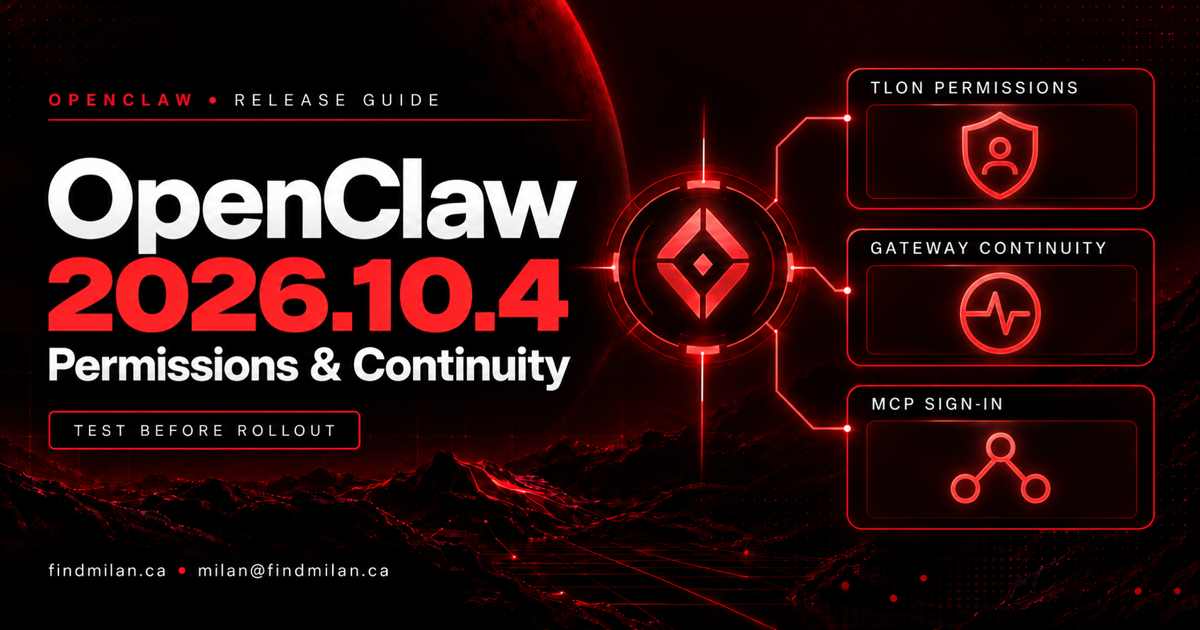
OpenClaw 2026.10.4 matters most to operators using Tlon, persistent Gateways or browser-connected workflows. The October 16 stable release closes an owner-impersonation path in Tlon group messages and fixes several failures that can interrupt otherwise useful agents.
It is a stability patch for 2026.10.3, not a major feature launch. The important question is which fixes affect your installation—and which limitations remain after updating.
What changed in 2026.10.4
The official release highlights Gateway continuity after sleep or clock changes, shutdown handling, Tlon authority checks, headless browser responsiveness and manual compaction.
It also addresses MCP OAuth login when authorization servers register a loopback redirect without a port. These changes are distinct from the credential-masking work covered in our 2026.10.2 guide.
For a small team, this is operational work rather than a reason to redesign the agent. Keep the existing task scope and permissions; test the affected paths before expanding usage.
Tlon: owner authority is fixed, but not every identity risk
The curated 10.4 notes say unverified group-DM author claims no longer gain owner commands, approval or admin actions, or elevated tool permissions.
They also disclose a remaining limitation: a group member can still pose as an allowed sender for ordinary agent chat, with replies going to that impersonated sender’s private conversation. Pending DMs saved before the update should be resent after approval.
Our recommendation is to review what an ordinary allowed sender can ask the agent to reveal or do. Removing an elevation path is not equivalent to establishing every message’s identity. Use a non-sensitive test conversation and retain approvals for consequential tools.
Do not label the release a complete fix for every Tlon impersonation scenario, or assign it an unsupported CVE or severity rating.
Gateway, browser and MCP checks
The Gateway fixes target false ownership-heartbeat restarts after sleep or clock jumps, plus shutdown hangs involving transcript workers or session lifecycle events. A useful regression test is a harmless conversation that resumes after normal sleep and wake, followed by a supported service restart and a fresh reply.
For browser workflows, the distinction is important: headless pages can stay clickable while blocking passkey prompts are dismissed. Passkeys still need a headed browser. Reload a page that was already stuck; do not assume the update can finish an authentication challenge for you.
For MCP, repeat one authorized sign-in and then a read-only tool request. Successful browser consent alone is not proof that the application received and can use the connection. Do not widen scopes to make the test pass.
Compaction and updates still need recovery awareness
Manual /compact now gives an active answer up to 60 seconds to finish. If it cancels the turn, the status tells the user to resend the original request. Check that status instead of assuming the outstanding task completed.
The updater changes also have a timing boundary. Some snapshot and scheduled-work improvements apply to later upgrades after installing 10.4. They do not retroactively replace the updater currently running on an older installation. Real database changes can still prevent automatic restoration.
The preceding 2026.10.3 notes discuss blocked-update recovery, retained sign-ins and memory, and installation-specific maintenance. Preserve recovery records and follow instructions to keep the Gateway stopped when repair work has not settled. Repeated installation attempts or deleting locks blindly can make diagnosis harder.
A controlled upgrade checklist
This is FindMilan’s suggested test plan, not a claim that we have tested your system:
- Record the version, installation owner, running service and enabled channels before changing anything.
- Make a supported backup and confirm the restore procedure. Keep recovery journals and snapshots until verification is complete.
- Use the update path for your installation. App-managed, container and CLI deployments need not share the same maintenance procedure.
- Test one normal reply, one affected channel, an MCP read, and a browser sign-in with non-sensitive data.
- Inspect the first harmless scheduled run and its actual result. A running Gateway is not proof that every job finished.
- Review errors and remaining limitations before returning consequential work to the agent.
Intentional approvals and required checks should survive the upgrade. An action being reversible does not authorize the agent to perform it.
What teams should prioritize
Review this release promptly if Tlon group messaging is enabled or your team has experienced the specific Gateway, MCP or browser failures described above. Avoid enabling unrelated integrations simply to try a patch.
FindMilan’s OpenClaw setup and support can help map those checks to a real deployment. Our agent setup project provides the broader context: reliable agents depend on permissions, service ownership and recovery—not only on model selection.
Official sources
- OpenClaw 2026.10.4 GitHub release
- OpenClaw 2026.10.4 detailed release notes
- OpenClaw 2026.10.3 recovery context
Sources checked October 16, 2026. Product changes are attributed to OpenClaw; the rollout checklist is FindMilan’s practical interpretation.
Frequently asked questions
Why should OpenClaw users review 2026.10.4?
It closes an owner-impersonation path in Tlon group DMs and addresses Gateway, browser, MCP sign-in and update failures. It is a stability patch for 2026.10.3, not a new-feature release.
Does the Tlon fix prevent all sender impersonation?
No. The official documentation says unverified group-DM author claims no longer gain owner or elevated authority, but chat-level allowed-sender impersonation remains possible.
Can headless OpenClaw browsers now use passkeys?
Not because of this fix. Headless pages remain responsive while passkey prompts are dismissed, but passkeys still require a headed browser. An already-stuck page needs reloading.
Do the updater fixes repair every older installation automatically?
No. Some improvements apply to later upgrades after 10.4 is installed. Existing blocked updates and real database changes can still require installation-specific recovery.