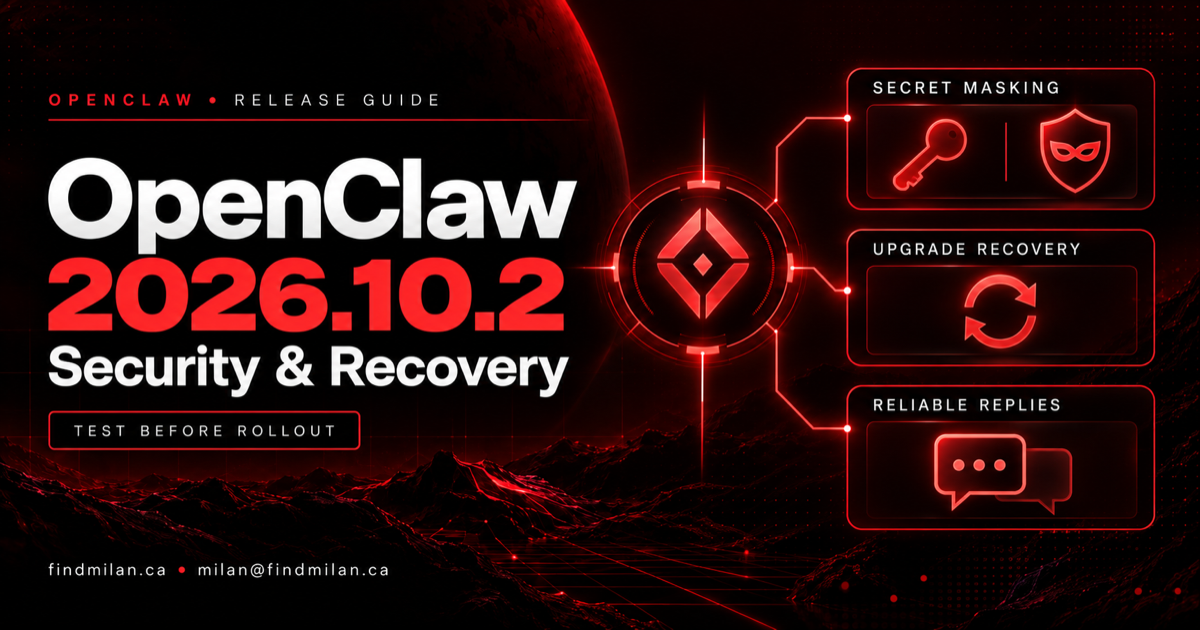
OpenClaw 2026.10.2 is worth reviewing if your agents process long tool output, run unattended jobs or have struggled with upgrades. Its practical value is in security and operational reliability—not a new permission to let agents do more without approval.
The stable release was published on October 12, 2026. This guide separates the documented changes from FindMilan’s suggested testing approach. We have not benchmarked the release or tested your installation.
What changed
The official GitHub release identifies fixes for credentials split across output chunks, problematic upgrade paths from 2026.10.1, Doctor recovery, truncated helper answers and interrupted background-tool workflows.
That combination makes this more consequential than routine maintenance for teams relying on persistent agents. A release that improves the surrounding workflow can matter even when the underlying model stays the same.
Treat secret masking as a safety net
An agent might inspect a build log, configuration dump or command response containing sensitive information. When that output is large, text processing becomes a security concern rather than simply a performance concern.
The masking repair is a reason to review the update promptly. It is not a reason to deliberately put production keys into test logs or assume every sensitive string is recognized.
For a safe regression test, use synthetic credentials and non-production fixtures. Include long output and sensitive-looking values near boundaries, then inspect the saved transcript and approved logging surfaces. Do not copy a real secret into a chat to see whether it disappears.
If you suspect an earlier exposure, updating the application is only one part of the response. Review the affected systems, restrict access to records, and rotate credentials where appropriate. A software fix cannot recall information already disclosed.
Verify an upgrade before repeating it
The curated release documentation adds an important caution: an older updater can show a cleanup error even after installation succeeds. Check the new installation with openclaw update status before treating the message as proof of failure.
This is a useful distinction for any deployment workflow: an error in reporting the outcome is not necessarily an error in applying the update. Conversely, an apparently successful installer does not prove that your channels, tools and scheduled jobs work.
Record the installed version, the update output and the service state separately. Then test a harmless end-to-end task through the interface you normally use. Avoid repeatedly reinstalling or deleting state because the first message is confusing.
Doctor’s recovery improvements should also be treated as targeted repairs, not permission to discard warnings or remove lock files blindly. Keep a verified backup and understand the restore procedure before consequential maintenance.
Long conversations need a cost check
Eligible direct OpenAI Responses and Anthropic API-key routes now use provider-managed compaction by default. The documentation warns that OpenAI manual /compact may cost more than a local summary because of uncached input.
For your team, the practical question is not simply whether a conversation continues. Check which route is active, what context survives, and what the usage record shows. Subscription-backed, API-key and CLI workflows should not be assumed to behave identically.
Try a representative non-sensitive conversation: give the agent a short specification, make several corrections, then verify that it retains the accepted requirements after context management. A fluent reply is not evidence that the important details survived.
Test replies and automation as complete workflows
The release also addresses scheduled-job tool access and helper-result delivery. For a team using agents to research, build or report on a schedule, the meaningful test is the entire chain—not whether a helper launched.
Use a harmless job with a clearly defined result. Verify that the main agent receives the right report, that the final user-facing response is complete, and that the requested artifact exists. Check for repeated actions as well as missing actions.
Keep intentional approvals in that test. An agent waiting for permission is different from an agent that has stalled. Do not remove approval boundaries to make a workflow look more reliable, and do not interpret reversibility as authorization to act.
A practical rollout checklist
Before upgrading a production agent:
- Record the current version, installation method, active provider routes and critical integrations.
- Back up the complete supported state and verify that you can restore it.
- Read the installation-specific cautions in the official notes rather than applying a generic command from another environment.
- Test with synthetic data: long output, a resumed conversation, a helper report and a scheduled job.
- Verify the running service and final artifacts after the update; retain a short record of failures and successful checks.
If something fails, narrow the failing path before changing configuration. Preserve evidence without retaining unnecessary sensitive content. Do not disable certificate checks, filesystem safeguards or human approvals as a shortcut.
Where this fits in your agent setup
Our earlier OpenClaw Atomic Updates guide explains a different release and its backup boundaries. This October update deserves its own operational review because it targets masking, recovery and execution reliability rather than repeating those earlier features.
FindMilan’s OpenClaw setup and support can help define that test plan around your actual tools and permissions. The agent setup project shows the broader deployment context: credentials, operating boundaries and recovery are part of the product, not tasks to postpone until something breaks.
Bottom line: prioritize a controlled review of 2026.10.2, especially where long output or unattended work is involved. Preserve safeguards, test real workflow boundaries with safe data, and judge success by the result the user receives.
Official sources
Sources checked October 12, 2026. The checklist and practical cautions above are FindMilan’s interpretation, not claims of testing or guaranteed security.
Frequently asked questions
Why does OpenClaw 2026.10.2 matter?
It addresses credential masking in long tool output, upgrade and Doctor recovery problems, and reliability failures affecting agent replies. Operators should test these paths against their own configuration.
Does the masking fix guarantee that no secrets can leak?
No. The documented fix concerns recognized credentials crossing output boundaries. Keep least-privilege credentials, restricted output and a response plan for suspected exposure.
Should I retry an update after a cleanup error?
Check the installed version and run openclaw update status first. The official notes warn that an older updater can report a cleanup error after an update has already succeeded.
Does provider-native compaction always cost less?
No. The documentation warns that OpenAI manual /compact can cost more than a local summary because it processes more uncached input. Check the route, settings and actual usage.